Search here without leaving this page

Custom Search

Untuk sebarang Pertanyaan/Perbincangan/Pesanan, sila emailkan ke

greenlegacy05@yahoo.com

Live World Sunlight Map - Peta Sinaran Matahari (Satelite View)

Tuesday, May 13, 2008

Greenhouse - Some important facts


Greenhouse
: A framed or inflated structure used for cultivating plants. It is covered with a transparent material that allows for optimum light transmission of the appropriate wavelengths
(i.e., photosynthetically active radiation or PAR). It protects against adverse climatic conditions and control of the environment to achieve goals (e.g., opt. yield, etc.). One of the first recorded greenhouses was built during the first century A.D. It was covered with “transparent stone”, probably sheets of mica, to grow cucumbers out of season for the Roman Emperor, Tiberius. A greenhouse must provide protection from adverse “abiotic” conditions such as heat cold rain wind sleet hail snow salt blowing sand
NOTE: Structures can also be built to protect plants against “biotic” factors, for example, cages covered with insect or bird netting to protect against insect and bird predation, respectively. However, these structures will not be considered here.

Structural members must be strong enough to prevent structural failure during adverse weather conditions but be kept to a minimum size and number to reduce the amount of shading and to provide for maximum light transmission. Greenhouse structures are rated for certain “design loads” (the load or weight supported by the structure):
  1. Dead Load = the greenhouse framing and everything hanging from it including the glazing (covering), pipes, heaters, fans, pads, shade cloth, motors, support cables AND any hanging crops or baskets in place more than one month.
  2. Live Load = transient greenhouse assembly or repair equipment, people (not swinging from the rafters!) who must climb onto the structure to perform various repairs, cleaning, servicing, etc. AND any hanging crops (e.g., tomatoes, peppers, cucumbers) or baskets in place less that one month.
  3. Wind Load = the load, in pounds per square foot, placed on the exterior of the greenhouse by wind. This will depend on :
  • The angle at which the wind strikes the greenhouse.
  • The shape of the greenhouse (height, width, number of bays, etc.).
  • Whether or not vents, doors, etc. are open or closed.
*NOTE: If a sufficient wind strikes the side of a greenhouse it could rip the roof off! (Local windbreaks – trees – can help.) Depending on the location, a typical “wind load” is 80 mph or 16 lb/ft2. The greenhouse frame needs to be secured to the ground against wind. With permanent structures, anchor the supports in concrete.
With temporary structures a cork screw device is used to anchor the greenhouse to the ground.
4. Snow Load = the load, in pounds per square foot, placed on the exterior of the greenhouse by snow accumulation. The type of snow makes a difference:
  • 12 inches of dry snow equals 5 pounds per square foot of load.
  • 3 inches of wet snow also equals 5 pounds per square foot of load.
  • and 9 inches of wet snow can collapse a greenhouse
When it starts to snow hard – increase the heat in the greenhouse to melt it. Early snow will melt easily. Succeeding snows will slide off. Building Codes:
  • Each state/country will have its own codes.
  • Sometimes agricultural buildings will be exempt from the codes or be treated as “special structures”.
*Example: Greenhouses can be built very cheaply in Mexico because Mexico has no building codes. However, these greenhouses may also not be as safe as if they were built to USA code.
*Always make sure the builder/contractor is insured

.


Digg Technorati del.icio.us Stumbleupon Reddit Blinklist Furl Spurl Yahoo Simpy

STRUKTUR RUMAH LINDUNGAN - Memahami Konsep 'Pertanian Berpelindung' / GREENHOUSE STRUCTURES - Understanding The Concept Of 'Protected Agriculture'


Definasi 'Pertanian Berpelindung' adalah 'pengubahsuaian terhadap persekitaran kawasan tanaman untuk mencapai tahap pertumbuhan yang lebih baik dan terkawal'. Teknik-teknik contoh Pertanian Berpelindung adalah termasuk:
  1. Sungkupan atau bahan sintetik maupun organik yang diletakkan atau dihamparkan atas tanah di sekeliling tanaman untuk menghasilkan keadaan yang lebih sesuai untuk pertumbuhan tanaman yang hendak ditanam serta menghambat pertumbuhan tumbuhan liar yang akan 'mencuri' baja yang akan diberi seperti rumput, lalang dan sebagainya.
  2. Lapisan penapis cahaya yang melindungi tanaman dari sinaran cahaya yang terlalu tinggi
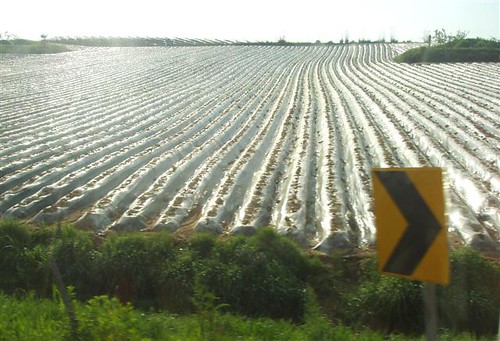
  3. Baris lapisan penutup plastik untuk melindungi anak pokok dari kesejukan pada awal misim dingin
  4. Struktur atap berpelindung dari plastik tetapi terbuka di bahagian tepi untuk melindungi tanaman dari hujan.
  5. Struktuk berpelindung yang tertutup sepenuhnya. Ia dikenali sebagai Rumah Hijau
  6. 'Penanaman Persekitaran Terkawal' (CEA) - Kawalan paling sempurna dalam 'Pertanian Berpelindung'. Pertumbuhan tanaman, selalunya di dalam rumah hijau adalah tertutup sepenuhnya, dengan kawalan dari segi suhu, kelembapan, bahagian-bahagian gas, pencahayaan, pengairan, media penanaman & pemberian larutan zat/pembajaan yang tepat, disukat & terkawal dari setiap tahap usia tanaman di bahagian atas (aras daun, batang & pembuahan) serta di bahagian bawah (aras perakaran) ____________________________________________________________________
The definition of Protected Agriculture is: 'the modification of the natural environment to achieve controlled or improved plant growth.' Protected agriculture can include:
  1. Mulches of organic or synthetic materials placed on the soil around the plants to make conditions more favorable for plant growth.
  2. Shade cloth to protect plants against high light intensity.
  3. Plastic row covers to protect young plants against the cold early in the season
  4. Open-sided, plastic roofed structures to protect against rain
  5. Totally enclosed structures, or “greenhouses”
  6. Controlled environment agriculture (CEA): The “ultimate” in protected agriculture. The growing of plants, usually in a greenhouse or totally enclosed structure (e.g., growth chamber), with control at the aerial and root levels of temperature, humidity, gas composition, light, water, growing medium and plant nutrition

.


Digg Technorati del.icio.us Stumbleupon Reddit Blinklist Furl Spurl Yahoo Simpy

Pembiakan Dari Tanaman Hidroponik / Hydroponik Propagation Method

Pembiakan tanaman hidroponik/aeroponik boleh dilakukan tanpa perlu melakukan penyemaian biji benih. Kedah ini lebih cepat dari segi hasil dan pertumbuhan tetapi perlu pemerhatian yang teliti terutamanya dari segi serangan penyakit. Pengusaha hidroponik/fertigasi/aeroponik boleh menggunakan kaedah ini untuk mengaturkan penghasilan yang konsisten dan cepat


Digg Technorati del.icio.us Stumbleupon Reddit Blinklist Furl Spurl Yahoo Simpy

Monday, May 12, 2008

Model Sistem Hydroponik EBB & FLOW


An Ebb and Flow system consists of a growing bed in which individual containers filled with medium hold your plant's root systems. The growing medium also acts as a buffer, holding water and nutrients around the root system, and reducing the risk of crop loss due to power or equipment failure. The growing bed is flooded periodically to feed and water the plants and allowed to drain freely to pull oxygen into the root zone. Ebb and Flow systems' low maintenance, high productivity, and ease of use make them among the most popular hydroponic systems for not only the beginner, but for the advanced gardener as well.

How do I build my own hydroponic system? Yes, you can build your own hydroponics system. We supply a variety of trays, pumps, filters, reservoirs, and other pieces that make building your own custom system a breeze. There are also many different types of hydroponic systems that are easily built from common parts that are usually readily available. Below we have illustrated a simple ebb and flow system made from components that we sell. Also, we have included a list of common pieces that can be found locally to build this system.
An ebb and flow system is one of the easiest hydroponic systems to build yourself. Many of the parts needed can be found locally, if not we carry a complete line of ebb and flow trays, NFT channels, reservoirs, hydroponic pumps and filters, fill and drain kits, etc. The principle behind an Ebb and Flow system is easily understood. A bottom reservoir contains nutrients which are periodically pumped up to the ebb and flow tray, and then allowed to drain via gravity back into the reservoir. When the Ebb and flow tray is flooded plants receive nutrients and water, also CO2 is pushed out and away from the plants root system. When the nutrient solution drains back into the reservoir, fresh oxygen is pulled down into the root system. This combination of fresh nutrients, water, and oxygen is then readily assimilated by the plants, ensuring lush healthy growth. Following is a list of parts that could be used to build an ebb and flow system out of componenets that we sell. Other alternatives are suggested below:
  1. 4'x2' ebb and flow tray
  2. 30 gallon reservoir
  3. Maxijet 500 pump
  4. American Hydroponics fill/drain kit
  5. 6' - 1/2" blue flexible tubing
  6. 3 hose clamps - 1/2"
  7. 30 - 4 1/2" square containers
  8. 50 litres LECA growing medium


Watch the video below for your guide to bulid this model system


Digg Technorati del.icio.us Stumbleupon Reddit Blinklist Furl Spurl Yahoo Simpy

Konsep Asas Keperluan Baja/Nutrien Hidroponik/Fertigasi


Pokok memerlukan sehingga 16-17 unsur 'perlu' untuk menjamin pertumbuhan pokok yang normal & sihat. Unsur-unsur ini dianggap 'perlu' kerana ianyan tidak boleh diganti sepenuhnya oleh unsur lain dan tumbesaran atau pembiakan pokok tidak boleh berlangsung secara normal tanpanya. Karbon, Hidrogen & Oksigen juga dianggap 'perlu' dan ianya menyelubungi lebih daripada 90% komposisi unsur dalam rumah hidroponik. Unsur-unsur ini boleh didapati daripada udara & air. Unsur-unsur 'perlu' lain yang penting untuk pokok membesar boleh didapati daripada nutrien yang dibekalkan dalam bentuk larutan.

Hanya sedikit sahaja unsur-unsur ini terkandung dalam jumlah berat kering tisu tanaman. Walau bagaimanapun, ketiadaan salah satu atau lebih dari unsur-unsur ini akan menjejaskan tumbesaran pokok.
Industri pengeluaran sayur-sayuran jenis daun boleh memberi pulangan yang lumayan. Berpandukan teknologi yang ada di MARDI sekarang ini, dengan harga jualan RM4 sekilo (harga di ladang), pengeluar sayur jenis daun secara hidroponik boleh mendapat pendapatan kasar diantara RM800 sehingga RM1000 sehari untuk tiap-tiap hari sepanjang tahun dari kawasan seluas 0.4 hektar (1 ekar).
Kekurangan nutrient biasa kelihatan pada tanaman yang diusahakan secara konvensional walaupun tidak menyeluruh iaitu bertompok-tompok di sana- sini. Ini disebabkan taburan nutrien yang memang ada di dalam tanah itu berbeza-beza dari satu sudut ke satu sudut lainnya. Pemberian nutrien tambahan dalam bentuk baja berbutir juga bukannya mudah untuk mendapatkan taburan yang sekata. Secara relatifnya juga, banyak baja akan dibazirkan dan tiada panduan untuk menganggarkan berapa peratuskah nutrien dari baja yang ditabur itu dapat diserap oleh pokok.
tetapi dalam sistem hidroponik yang mengeluarkan baja larutan yang diperolehi dari sumber yang diakui, sukar bagi kita untuk tidak melihat sebarang tanda-tanda kekurangan nutrien pada pokok lebih-lebih lagi jenis yang berkitar larutannya. Walau bagaimanapun, tanda-tanda kekurangan ferum biasa dilihat pada pokok sayur jenis Kailan terutamanya apabila pH nya melebihi 6.5. Manakala kekurangan Kalsium biasa terdapat pada pokok Tomato terutamanya apabila cuaca terlalu panas dengan tanda-tanda kejadian penyakit Blossom End Rot pada buah Tomato.
Pembajaan dalam penanaman hidroponik biasanya dapat dilakukan dengan lebih tepat dan dianggap menjimatkan. Ianya dapat dilakukan dengan alat E.C meter untuk menyukat kepekatan baja/nutrien di dalam larutan. bagi tanaman sayur jenis daun, nilai bacaan E.C adalah di antara 2.0 - 2.5 mS/cm manakala jenis tanaman buah lebih tinggi lagi bacaannya (2.5 - 4.5 ms/cm). Dengan menggunakan alat ini, masalah pembajaan yang berlebihan hingga menyebabkan toksik kepada pokok tidak akan timbul. Jika bacaannya tinggi, ianya mudah dibetulkan dengan menambah air bersih untuk mencairkannya.
Video di bawah menunjuk salah satu alatan berketepatan tinggi yang digunakan untuk menyukat jumlah kepekatan nutrien, pH dengan tepat untuk mengoptimakan penggunaan baja dan memaksimakan hasil tanaman


Digg Technorati del.icio.us Stumbleupon Reddit Blinklist Furl Spurl Yahoo Simpy

Sunday, May 11, 2008

GREENHOUSE ENERGY CONSERVATION METHODS FOR HEATING

It looks simple, but that Argus box contains a sophisticated greenhouse climate controller. Each greenhouse had one of these. Talk about expensive! Those big exhaust fans keep the air moving so the little plants can breathe


Rows of greenhouse with individual exhaust fans

As far as greenhouse farmer and Hydroponic/fertigation growers are concern, heating and cooling are obviously a significant part of their operating budget. Any measures that reduce the need for heating and cooling will reduce the costs for these as well, and will therefore increase profit (the bottom line for a commercial grower, schools and even home gardeners!).
There are several methods can be outlined to conserve energy in a greenhouse as well as alternatives to “traditional” methods of heating.
  • Greenhouse orientation: In northern latitudes single bay greenhouses can be oriented east-west to allow maximum light reception in the late fall, winter and early spring. For multiple bay, gutter-connected greenhouses the orientation is usually north-south so that the shadows from the gutters track from west to east across the crop rather than shading the same areas all day. In either case, the rows of plants within the greenhouse should run north-south to optimize equal light to all plants throughout the day.
  • Windbreaks to save on heating: A wind of only 15 mph can double the heat loss from a greenhouse. A wind reduces the thickness and therefore the insulating effectiveness of the thin air layer (boundary layer) along the greenhouse glazing. A wind will essentially “suck” heat away from a greenhouse faster than if the air was still. Windbreaks, in the form of fences, trees, buildings, etc. can slow the wind and therefore cut heat losses from the greenhouse. Windbreaks are most effective with older, leaky greenhouses or in high wind areas. However, older greenhouses should be upgraded since this will save far more money in heating costs than any windbreak.
  • Use of double verses single layer glazings: Double layer glazings, with at least a ¼” insulating layer of air in between, can reduce the conductive heat loss by up to 40% over single layer glazings. Using triple layered glazing or, for example, a double layer of polyethylene overglass, can further cut heat loss, but it will also reduce solar radiation, so this is very rarely done.
  • Structural insulation: Insulating materials can be applied to the foundation of the greenhouse, to the north wall (in the northern hemisphere) and to the walls up to the height of the plants to reduce conductive heat loss. Weather stripping and other insulating materials should be added where ever there are gaps in the structure. This includes around doors and vents and whereglazing panels meet the structural supports. If the glazing material is cracked (ripped polyethylene, broken glass panes or cracked poly acrylic or carbonate) replace immediately to reduce heat loss.
  • Inflatable tube insulation: Polyethylene tubes (6-18” in diameter) can be hung from the greenhouse ceiling. When inflated they create an effective insulating barrier to heat loss through the ceiling (up to 40%). Make sure the tubes fit snuggly along the walls. Since polyethylene above the crop will reduce light transmission, tube systems have been designed to be retractable or removable during the day. Though effective, these systems are rarely used in commercial operations.
  • Retractable heat or insulating blanket or curtain: Porous, non-porous and aluminized materials are all used as insulation blankets. The material can be single or multiple layers: more layers giving more insulation. The material, placed between the ceiling and the crop, must be secured along the walls to minimize cold air above falling through onto the crop. These curtains can be used during the day in the summer for shading as well. These retractable curtains are perhaps the most cost effective.
  • IR coatings on polyethylene films: These infrared barrier films allow heat into the greenhouse during the day (requiring a bit more venting or cooling) but significantly reduce heat loss at night by as much as 30%.
  • Other insulating methods – experimental: Polystyrene beads have been used by blowing them into the air space between two glazing layers. Energy savings may amount to 60-90% annually. Liquid foam (or soaps) can be blown into the air space between two glazing layers for an energy savings of perhaps as much as 50%. A disadvantage of this is that most foams break down in cold. Unfortunately, neither of these experimental methods are currently practical.
  • Equipment operation and maintenance: Maintain the heating equipment (check for leaks, valve operation, thermostats, etc.) so that it operates at peak efficiency. Insulate supply and return hot water/steam pipes. Inspect regularly. Choose the most efficient and cost effective fuel: In most places, natural gas.
  • Solar Heat: This method has gained popularity recently because of its efficiency & also cost effective as to compare to most of other methods mentioned above. This video shows how


Digg Technorati del.icio.us Stumbleupon Reddit Blinklist Furl Spurl Yahoo Simpy

GREENHOUSE ENERGY CONSERVATION METHODS FOR COOLING

In northern latitudes (Canada, England, Holland, etc.) the cost for heating, especially, and cooling a greenhouse for hydroponic can amount to 70 – 85% of the total operating costs. In warmer areas (the Southwest United States, Mexico, Spain, Tropical Asian countries, etc.) the costs can still be around 50% of the total operating costs. Therefore, heating and cooling are obviously a significant part of the operating budget. Any measures that reduce the need for heating and cooling will reduce the costs for these as well, and will therefore increase profit (the bottom line for a commercial grower, schools and even home gardeners!).There are several points to be considered in order to make the greenhouse environment cool and well ventilated for the energy conversation:


  1. Structural considerations: As with heating conservation, insulation and weather stripping can reduce infiltration of hot outside air into the greenhouse which will reduce cooling needs. Damaged glazing materials should also be replaced. Taller greenhouses (16-22 feet, about 5 to nearly 7 meters) are better since hot air will rise away from the crop.
  2. Equipment operation and maintenance: Maintain the cooling equipment so that it operates at peak efficiency.
  3. Passive measures: Energy savings can be realized by using shade cloth or paint.


Learn the basic of how to keep things cool in 'Ventilation And Cooling' , a jam packed minute about the passive and active cooling systems utilised in the University Of Arizona's Hydroponic greenhouse (by the The Control Environment And Agricultural Center or CEAC Web Team). Brought to you via Macromedia Flash.


Ventilating fan & Fog system can reduce the heat in a greenhouse


Digg Technorati del.icio.us Stumbleupon Reddit Blinklist Furl Spurl Yahoo Simpy

Drip Irrigation System of Precision Farming in the US modern farm

This method shows the system of the modern farming concept in which we used to call FERTIGATION (Fertilization and Irrigation) or Drip Irrigation whereby the hidroponic fertilizer (in the form of liquid and pre-determined concentration using the calibrated E.C meter) is transported through a P.E and Poly piping and end at the microtube dripper to individual unit of plant. By using this method, each plan is getting the same and consistent amount and also the same concentration of fertilizer and thus, optimise the fruitings

Perusahaan Hidroponik sayur Selada (Lettuce) skala besar di USA

Perusahaan Hidroponik penanaman sayur Selada berskala besar ini dirakam dari dokumentari di Discovery Channel