Search here without leaving this page
Untuk sebarang Pertanyaan/Perbincangan/Pesanan, sila emailkan ke
Live World Sunlight Map - Peta Sinaran Matahari (Satelite View)
Wednesday, December 10, 2008
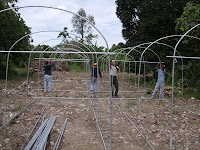
Pemasangan Set-Up Fertigasi

Technorati:
Sistem Fertigasi/Fertigation System
Tuesday, May 20, 2008
Thursday, May 8, 2008
FERTIGATION SYSTEMS - Nutrient Delivery Systems & Solutions
SISTEM PENYALURAN ZAT
2) Sistem Kompleks - Sistem yang dikitar semula, penyaluran atas, Autopot, NFT atau Aeroponik yang memerlukan pam untuk menyalurkan zat dari kawasan takungan atau dari beberapa tangki kepada tanaman melalui paip-paip PVC, Poly, tiub-tuib penitis dan sebagainya.
LARUTAN ZAT
1) Bekalan Air utama 2) Perigi-perigi 3) Air sungai atau air bukit 4) Tempat takungan air hujan
Bekalan air haruslah mempunyai kuantiti & kualiti yang sesuai:
Kuantiti - Mestilah cukup untuk tanaman atau untuk tujuan penyejukan. Contoh, untuk tanaman Hidroponik Tomato, biasanya memerlukan 4Liter/pokok/hari atau jika 2.5pokok/m2, maka 10 Liter/m2/hari
Kualiti - Faktor2 yang diambil kira ialah nilai pH, EC (kepekatan garam) dan kehadiran bahan cemar
- pH - Mengukur kadar keasidan larutan (skala 0 - 14). Kaedah menguji pH - Kertas Litmus/pH meter. Bagi kebanyakan pokok, pH 5-7, untuk Tomato = 5.8 - 6.3. pH di atas 7 selalunya menyebabkan masalah pengagihan zat. Di bawah pH 5 pula akan menghambat penyerapan zat oleh pokok menyebabkannya kekurangan zat serta membantutkan kadar pertumbuhannya.
- EC - Mengukur jumlah garam di dalam larutan. Air yang murni tidak boleh mengalirkan arus elektrik, EC = 0. Semakin tinggi kandungan garam, semakin tinggi nilai E.C. Unit ukuran adalah dalam mS/cm. Kawasan2 tertentu mengandungi tahap garam yang berbeza di dalam punca airnya: * Kandungan Boron, Florida, Klorida, Sulfat dan Sodium yang tinggi akan menyebabkan pertumbuhan tanaman menjadi lembab.*Kadar zat besi yang tinggi boleh menyebabkan bintik-bintik seperti karat pada daun tanaman.*Tahap garam yang tinggi juga boleh menyebabkan timbunan garam pada pad penyejuk yang akhirnya perlu diganti dengan lebih kerap
- TDS (total disolved solids) - Untuk mengukur bahan cemar iaitu kehadiran bahan2 logam berat dalam kandungan bekalan air. Kandungan bahan Plumbum, Kadmium, Aluminium yang tinggi di dalam air boleh diasingkan/ditapis atau diserap oleh tanaman dalam jumlah yang sedikit tetapi tidak mendatangkan apa-apa bahaya pada tanaman
_______________________________________________________________
NUTRIENT DELIVERY SYSTEMS
- Simple systems: Non-recirculating/air gap system or the raft system where the roots hang down directly into the nutrient solution. Basic wick system in which the nutrient solution is drawn up by an absorbent wick into an aggregate where the roots grow.
- Complex systems: The flood and drain, top feeder, NFT or Aeroponic systems all of which require pumps to move the nutrient solution from a reservoir or series of tanks to the plants via PVC, poly and drip tubing, emitters, etc.
NUTRIENT SOLUTIONS
Any hydroponic nutrient solution begins with the “source water”. A grower can obtain source water from:
1) City water supply 2) Private wells 3) Water harvesting (channeling rain water into catchments)
The source water must have the appropriate quantity and quality:
Quantity: There must be sufficient water available for plants and for cooling. Ex: For tomatoes in greenhouse hydroponics: ~4 liters/plant/day or if 2.5 plants/m2, then 10 liters/m2/day.
If evaporative cooling is used, especially in desert areas, water needs may be doubled!
Quality: Factors to consider include pH, EC (salt levels) and contaminants:
1) pH: The p(Potential of) H(ydrogen): Acid or base character of the water. pH = - log [H+] (neg. log of the H+ conc.) Scale = 0-14 Ex:
- If [H] = 10-7, then pH = 7 (Neutral)
- If [H] = 10-4, then pH = 4 (Acidic)
- If [H] = 10-9, then pH = 9 (Basic)
For most plants: pH 5 – 7. For tomatoes: 5.8 – 6.3. Above pH 7 may cause problems with nutrient uptake. Below pH 5 may cause abnormal absorption of certain ions resulting in deficiencies or toxicities.
2) EC (Electrical conductivity): a measure of the total salts in water. Pure water (no salts) does not conduct electricity: EC = 0. The higher the salt levels, the higher the EC. Measured in: mS/cm (milli-Siemens per centimeter)
Elevated salt levels: Certain geographic areas have high salt levels in the water :
- High boron, fluoride, chloride, sulfates and sodium: -Can cause poor plant growth. -May influence soluble salt levels in the water.
- High iron, especially in “hard water” (having high Ca and Mg): -Can cause rusty spots on leaves with overhead irrigation.
- High salt levels can also cause rapid salt buildup on cooling pads. -May need to bleed off and replace pad water regularly.

Technorati:
Sistem Fertigasi/Fertigation System
Monday, May 5, 2008
High Tunnel Fertigation Method
High tunnels are plastic-covered, solar greenhouses that can be used for early-season cucurbit production. High tunnels are low-cost, passive, solar greenhouses that use no fossil fuels for heating or venting (Figure 1). High tunnels can provide many benefits to horticulture crop producers:
- High tunnels are used to lengthen the growing season of crops.
- High tunnels protect the growing crop from environmental stress such as drought, driving rain, wind and temperature extremes.
- High tunnels protect crops from insect and disease invasion.
- High tunnels are well suited for producing heirloom and specialty vegetables that require a specific growing environment.
Many warm-season (frost-sensitive) vegetable crops can be grown in a high tunnel. Cucurbits are a large, diverse group of warm-season plants in the Cucurbitaceae family. Cucurbits include many popular vegetables such as cucumber, gourd, cantaloupe (muskmelon), squash, pumpkin and watermelon and are an important dietary source of fiber, minerals, beta-carotene and vitamin C.

Technorati:
Sistem Fertigasi/Fertigation System
Wednesday, April 30, 2008
Understanding The Concept Of Fertigation
Use of fertigation is increasing in U.S, Europe and Asian countries as producers strive to be more efficient with production inputs and practice good environmental stewardship. It is usually practiced with high value crops such as vegetables (strawberries, tomatoes, cucumbers, melons, etc.), turf, fruit trees, vines, and ornamentals. The main advantage of fertigation is the application of nutrients at the precise time they are needed and at the rate they are utilized. Yields are optimized and fertilizer costs are reduced because the nutrients are applied when, where, and in the soluble form needed.
Overall, fertigation conserves water and nutrients. Factors to consider with fertigation are • water quality (especially in drip/ trickle systems), • soil type/leaching potential, • daily plant nutrient consumption, • potential nutrient precipitation and volatilization, and • appropriate nutrient materials. Fertigation systems have been developed for many crops to provide nutrient management guidelines. In addition, plant, soil, and water analyses provide information to optimize the whole program.

Technorati:
Sistem Fertigasi/Fertigation System
Sunday, April 27, 2008
Perbandingan Antara Fertigasi & Penanaman secara Konvensional
- Jenis tanaman - Fertigasi: lebih sesuai untuk tanaman jenis buah / Konvensional: Sesuai untuk semua jenis tanaman.
- Struktur Pelindung Tanaman - Fertigasi: Pra-syarat yang mesti ada / Konvensional: Boleh dijalankan tanpa struktur pelindung tanaman
- Dinding jaring kalis serangga - Fertigasi: Boleh ada atau tiada / Konvensional: Tiada
- Sistem Pengairan - Fertigasi: Titis dan berbaja / Konvensional: Sebarang jenis pengairan
- Media Tanaman - Fertigasi: Coco-peat, pasir campuran, arang sekam padi, perlite, peat-moss, vermiculite dll / Konvensional: Tanah
- Veriety Tanaman - Fertigasi: Untuk Tomato, Cili & Melon jenis indeterminate atau hybrid / Konvensional: Indeterminate & determinate atau sebarang jenis veriety.
- Air - Fertigasi: Perlukan air bersih sahaja (paip, air bawah tanah atau air sungai yang bersih) / Konvensional: air bersih bukanlah pra-syarat untuk pengairan.
- Tenaga elektrik - Fertigasi: Sebaiknya ada / Konvensional: Tidak perlu
- Modal - Fertigasi: Tinggi / Konvensional: Rendah
- Pengetahuan Teknikal - Fertigasi: Sangat diperlukan terutamanya dalam pengurusan tanaman dan pengairbajaan / Konvensional: Tidak memerlukan pengetahuan yang terlalu teknikal.
- Tapak tanah (topography) - Fertigasi: Mesti rata supaya pengairan sekata kepada setiap unit tanaman / Konvensional: Tidak semestinya rata.
- Kesuburan Tanah - Fertigasi: Tidak menjadi syarat / Konvensional: Pra-syarat. tanah yang subur perlu untuk mengurangkan kos pengurusan dan penyediaan tanah
- Kos Operasi - Fertigasi: Rendah / Konvensional: Tinggi kerana melibatkan kos meracun rumput, membajak, membuat batas, merumput dan membaja (secara manual)
___________________Fertigation is the application of fertilizers, soil amendments, or other water soluble products through an irrigation system. Chemigation, a related and sometimes interchangeable term, is the application of chemicals through an irrigation system. Chemigation is considered to be a more restrictive and controlled process due to the potential nature of the products being delivered (pesticides, herbicides, fungicides, etc.) to cause harm to humans, animals or the environment. Therefore chemigation is generally more regulated than fertigation.
Fertigation is used extensively in commercial agriculture and horticulture and is starting to be used in general landscape applications as dispenser units become more reliable and easy to use.
Benefits of fertigation over traditional broadcast or drop fertilizing methods include:
- Increased nutrient absorption by plants
- Reduction in fertilizer and chemicals needed
- Reduced leaching to the water table
- Reduction in water usage due to the plant's resulting increased root mass being able to trap and hold water
- Cost Savings - Usually when factors such as labor, fuel, and interrupted play are factored into traditional fertilizer applications, significant cost savings can be seen from use of
fertigation techniques. Additionally, using fertigation, you can usually get the
same results from using inexpensive liquids as you can from expensive time release
granular fertilizers - Consistent Nutrient Levels - Feeding low levels of nutrition continuously as opposed to intermittent applications provides improved turf consistency.
- Reduced Labor - Fertigation reduces the amount of labor required to apply granular fertilizers or sprayed out foliars.
- Low operational costs

Fertigation In Malaysia
(mostly in Cameron Highland), capsicum, tomatoes, chillies, etc. New and modern approach is also added in the fertigation system in order to get the highest return. Some of them are the 'Autopot fertigation system' which is now used mainly in Sweet Melon fertigation plantation. This technique are very different from all other hydroponic systems such as NFT and drip to waste where the accurate dose of nutrients can be achieved. Delivering accurate nutrients to the plants without the salt build up problems many hydroponics experts expect. There is no run-off and no flushing is needed. The yields are good and the flavour of the melons is consistently outstanding. The sweetness measures an average brix reading of 14. The fruit are uniform and free from blemishes. The Autopot System is becoming very popular now in Malaysia even though the set up cost is huge. This shows that more and more Malaysians have a good faith in this technique. As a proof, we can see so many greenhouse structures in many parts of Malaysia now, even alongside the North-South highways. Malaysian goverment are also very supportive in this area. The good example are the Department Of Agriculture of Malaysia and Malaysia A
griculture, Research and Developement Institute or MARDI. They provide free training and courses for those who interested in venturing into this field. Some of the courses are as such:i) Agriculture Certificate
To produce skilled personnel in agriculture at operational level to fulfill th e need for the government and the private sectors.
To develop and produce for future agriculture entrepreneurs.
ii) Agriculture Incubator Training
To provide skilled training and exposure to commercial farming operation to entrepreneurs and young farmers for 8 months.


Technorati:
Sistem Fertigasi/Fertigation System