Search here without leaving this page

Custom Search

Untuk sebarang Pertanyaan/Perbincangan/Pesanan, sila emailkan ke

greenlegacy05@yahoo.com

Live World Sunlight Map - Peta Sinaran Matahari (Satelite View)

Friday, May 16, 2008

SISTEM KAWALAN DI RUMAH LINDUNGAN - Penyejukan / GREENHOUSE CONTROL SYSTEMS – Cooling

Kepentingan: Suhu yang terlalu tinggi boleh menjejaskan pertumbuhan tanaman. Ia boleh mengakibatkan masalah2 berikut:
  • Batang yang kurus teutamanya pada pangkal tangkai tanaman tomato
  • Mengurangkan saiz bunga terutamanya pada tanaman tomato yang menghasilkan bunga bercantum & pembentukan bengkak
  • Melambatkan proses pembungaan dan/atau pendebungaan yang tidak berkesan untuk menghasilkan buah.
  • Kemusnahan bunga/putik buah
Keperluan Penyejukan & Pengiraannya - 8 kaki persegi untuk setiap minit/kaki persegi bagi keluasan lantai rumah atau jumlah 1 lot rumah dibanding dengan kepanasan cuaca setiap minit.
CFM = (tinggi X lebar X panjang)
Contoh, Jumlah kawasan bawah + jumlah ruang persegi atap,
(8 X 24 X 48) + (6/2 X 24 X 48) = 9216 + 3456 = 12,672 kaki persegi/min (saiz kipas mengikut ruang kawasan ini).

Pengudaraan Pasif:

  1. Teduhan - Jaring peneduh atau cat putih khas mengawal kadar kecerahan sinaran cahaya (light intensity) yang terlalu terik dan mengurangkan kepanasan
  2. Ruang Rabung Terbuka - Rabung atap yang terbuka bertujuan untuk melepaskan kepanasan/angin panas dari dalam. Kawasannya mestilah 25% dari ruang lantai.
  3. Dinding yang digulung ke dalam - Ia bertujuan untuk melepaskan udara panas dari arah tepi
  4. Menara penyejuk - Lapik basah yang dingin di bahagian atas menara menyejukkan udara sekitar
  5. Atap boleh buka - Rekabentuk terbaru membolehkan atap dibuka sepenuhnya untuk membolehkan pengudaraan semulajadi
Sistem Penyejukan Aktif:
  1. Kipas & pelapik basah - 'Penyejukan Sejatan' di mana udara dari luar disedut melalui lapik basah yang mudah menyerap (selalunya kertas selulosa). Kepanasan dari udara akan menyejatkan air dari pelapik itu dan meningkatkan kelembapan relatif di rumah lindungan.
  2. Sistem Semburan Kabus - Menggunakan penyejukan sejat/sedut tetapi menggunapakai titisan air halus yang menyejat dan menyedut kepanasan dari udara. Sistem ini lebih merata kerana kabus air dilepaskan di sekitar rumah dan bukannya dilepaskan berhampiran dengan pelapik basah dengan kipas. Lebih kecil saiz titisan air, lebih cepat ia tersejat dan lebih cepat proses penyejukkan. Ukurlilit titisan kabus air yang efektif = 1000 miro-meter
  3. Alat Hawa Dingin - Terlalu mahal untuk rumah lindungan secara komersial
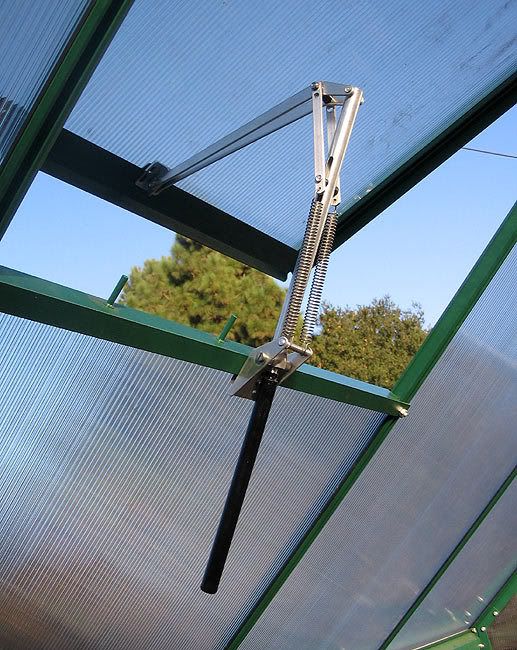
    exhaust fan in gh frameAutomatic Vent Control
_____________________________________________________________

Importance: High temperatures can be detrimental to plant growth. High temperatures can cause such problems as
  • Thin, weak stems or, as in tomatoes, stick trusses (thin, weak truss stems)
  • Reduced flower size or, as in tomatoes, flower fusion and boat formation
  • Delayed flowering and/or poor pollination/fertilization and fruit set
  • Flower and bud/fruit abortion
*Cooling requirements and calculations: The National Greenhouse Manufacturer’s Association 1993 standards = 8 cubic feet per minute/square feet of greenhouse floor area OR…
1 full greenhouse volume exchanged per minute in warm climates. CFM = height x width x length (i.e., volume)
Example: Using the greenhouse dimensions in the heat calculation example:
CFM = volume lower section + volume triangular top
= (8 x 24 x 48) + (6/2 x 24 x 48)
= 9216 + 3456
= 12,672 cubic feet per minute => size fans/pads accordingly

*Passive ventilation systems:
  1. Shading: Shade cloth or shade paint/white wash, besides regulating the light intensity, can also help cool the greenhouse.
  2. Ridge Vents: Vents in the roof of a greenhouse that allow hot, interior air to escape. The area of the vents should be 25% of the floor area.
  3. Roll-up Side Walls: Can be used in flexible glazing (polyethelene film) single bay greenhouses where the side walls can be rolled up several feet allowing a natural horizontal flow of air over the plants. As with ridge vents, the area of the side wall vents should be 25% of the floor area.
  4. Cooling Towers: Water cooled pads at the top part of tall towers cool the surrounding air which then drops displacing warmer air below.
  5. Removable Roof: Recent greenhouse designs can include a roof that retracts completely for natural ventilation. This would allow for adaptation of greenhouse grown plants to outside conditions prior to movement outside.
*Active cooling systems:
  1. Fan and Pad: “Evaporative cooling” where air from the outside is pulled through porous, wet pads (usually cellulose paper). Heat from the incoming air evaporates water from the pads, thereby cooling the air. Evaporative cooling will also help to increase the relative humidity in the greenhouse.
  2. Fogging Systems: Uses evaporative cooling like the fan and pad but incorporates a dispersion of water droplets that evaporate and extract heat from the air. This system gives better uniformity since the fogging is distributed throughout the greenhouse and not just near one a pad end as with the fan and pad system. The smaller the droplet size, the faster each droplet evaporates and therefore the faster the cooling. Mist droplets = 1000 microns in diameter.
  3. Air Conditioning: Too expensive for most greenhouses


Digg Technorati del.icio.us Stumbleupon Reddit Blinklist Furl Spurl Yahoo Simpy

Thursday, May 15, 2008

GREENHOUSE CONTROL SYSTEMS – Heating

  • Importance: Each plant species has an optimum temperature range. Heating devices

    will maintain the temperature within that range during periods of cold weather.
    *Types of heat loss from a greenhouse:
  • Conduction = Heat transfer either through an object or between objects in contact. Conduction depends on area, path length, temperature differential and physical properties of the object(s). Example: Heat loss through the glazing material on the greenhouse.
  • Convection = Heat transfer by the movement of warm gas or liquid to a colder location. Convection depends on temperature differential. Example: Movement of warm air near the plants upward toward the roof.
  • Radiation = Heat transfer between separated objects. Radiation occurs from all objects and depends on the areas, temperatures and surface characteristics of the objects involved. Example: Heat transfer from all objects in the greenhouse.
It is important to be able to estimate the heat loss from the greenhouse in order to choose the correct size of heater to replace that heat. Although radiation and convection transfer heat around the greenhouse, the main type of heat loss from a greenhouse is through conduction, i.e., the heat loss through the glazing material.
*The basic system: Consists of a fuel burner, heat exchanger, distribution system and controls. Heat delivery to the crop is by convection and radiation. The fuel = usually burn natural gas, but can also use oil, coal, wood, etc.
  • Heating by hot water or steam: Hot water or steam can be produced using boilers fired by natural gas, etc. The hot water or steam is then transported throughout the greenhouse in pipes. The pipes can end in a heat exchanger where a fan distributes heated air. The pipes can run along the floor and also be used as cart rails between aisles. Heat will then rise upward through the crop by convection. Heat pipes can also be positioned within the crop to steer plant growth . Heated tubes can create “bottom heat” for propagation or growing.
  • Heating by hot air: Fuel is burned to heat air that is then distributed by fans around the greenhouse. Horizontal air flow (HAF) fans circulate warm air above the crop. Fan jet systems, with unit heaters or heat exchangers and perforated polyethylene tubes, distribute warm air and improve air movement and ventilation throughout the greenhouse.
  • Moveable nighttime insulation: Insulating material (cloth or film curtains) can be positioned above the crop or near the roof to retain heat near the crop. The insulating material used during the night can be the same material used for shading during the day.
Those are called dual fin heating tubes. The hot water from the boilers enters into these tubes, which radiate the heat out towards the plants


Digg Technorati del.icio.us Stumbleupon Reddit Blinklist Furl Spurl Yahoo Simpy

Bagaimana Hendak Memulakan Model Fertigasi Cili?


Post kali ini ditujukan khas buat kawan baik saya, Hafiz (dan adik-adiknya) dari Bandar Baru Uda, Johor Bahru yang sekarang ini sedang 'kemaruk' nak mengusahakan tanaman cili secara fertigasi di kampungnya tetapi bercadang hendak memulakan dengan sebuah model kecil dulu (dalam saiz rumah lindungan 6' X 8' dengan menggunakan atap arcylic atau polycarbornat). Mungkin yang dia maksudkan seperti gambar di atas tetapi saiz yang dia cadangkan terlalu kecil. Dengan saiz 6'X8' hanya boleh menempatkan 8 pokok sahaja, itupun akan menjadi sukar untuk lalu lalang terutama jika enclosed dengan netting. Net yang hendak dipasang mestilah dari jenis greenhouse Vege Net dgn lubang bersaiz 32 mesh dan berwarna putih seperti ini ------->
Saiz 32 mesh adalah saiz rongga yang paling kecil untuk jaring kalis serangga.
Ini adalah mustahak kerana serangga yang harus dielakkan bagi pengusaha cili adalah bersaiz kecil terutamanya whitefly (lalat putih) yang saiznya 3 kali lebih kecil dari nyamuk dewasa. Kos untuk vege net berjejaring 30' (8X6X8X6) adalah dalam RM100+ sahaja.
Tetapi di sini, saya nak mencadangkan pada Hafiz, tak perlu bina model yang terlalu kukuh dan guna kos yang tinggi (terutama untuk atap arcylic yang mana 3 keping dah mencecah RM120). Saya ingin mencadangkan agar membina model rumah lindungan yang dipanggil 'lean-to greenhouse' (seperti pada gambar) yang mana struktur rangkanya dibina bersambung dengan dinding rumah (dengan syarat ia mendapat sinaran matahari terutama pada waktu fotosintesis iaitu dari pukul 9.30 ke 11am). Struktur rangkanya boleh dibuat dari paip PVC yang disambung-sambung menyerupai struktur rumah (oh ya, sebelum itu, masukkan pasir atau rangka besi ke dalamnya dan padatkan-supaya ia tahan lama & tidak melengkung kerana faktor suhu & cuaca). Kos penggunaan net/jaring kalis serangga juga adalah kurang dari struktur yang berdiri sendiri (single built). Plastik greenhouse film boleh digunakan sebagai penutup atap menggantikan kepingan arcylic yang mahal. Guna bahan PVC sebagai struktur rangka jauh lebih murah dari menggunakan kayu dan dengan itu, kos keseluruhan dapat dijimatkan. PVC bersaiz tebal dan berdiameter 15" hanyalah berharga RM0.70/kaki atau mungkin lebih murah. Joint/penyambung 'L' & 'T' hanyalah dalam 60sen ke 70sen seunit. Gambar2 berikut saya sediakan sebagai contoh rujukan model rumah lindungan yang boleh difikirkan. Amacam Hafiz, ok tak? Struktur2 rangka PVC


Seperkara lagi, saya tidak bersetuju dengan cadangannya untuk membuat siraman manual kerana sangat tidak praktikal serta membazirkan baja. Mungkin dia bernggapan bahawa dengan melakukan siraman manual dapat menjimatkan kos lagi. pada hakikatnya tidak begitu. Saya cadangkan agar dia menggunakan set up pengairan titis asas fertigasi yang secara totalnya sangat murah (untuk set kecil sebagai model). Mari kita estimate nilai keseluruhan kos untuk set pengairan automatik 8 point pokok cili tersebut:
  1. Timer digital (lihat gambar) : RM32

  2. Set Penitis/microtube/nipple : RM12 (RM1.50/set)

  3. Pam akuarium (20w) submisable : RM25

  4. 16" lateral tubing/hose : sekitar RM5

  5. 1 tong bekas baja :RM8 (tong sampah hitam yang saya beli di hypermarket)

Jumlah = RM 82 sahaja yang sangat praktikal daripada kaedah manual (walaupun tidak perlu membayar upah). Bayangkan-bagaimana nak appoint orang untuk membuat siraman manual 5 ke 6 kali sehari bermula seawal 6.30 pagi setiap hari selama lebih dari 3 bulan? Mmm.. jenuh, jenuh. Silap-silap, ter..miss siram, pokok pula boleh layu. Banyak baja akan terbazir berbanding pengairan titis yang lebih efisyen. Seperkara lagi, jika terlalu kerap kita keluar masuk ke dalam rumah lindungan yang bertutup sepenuhnya juga tidak digalakkan. Ini adalah kerana kita mungkin akan membawa masuk serangga kecil yang melekat pada badan kita. Oleh itu, siraman secara automatik adalah alternatif yang paling efektif untuk sistem fertigasi.
Untuk jumlah yang sangat sedikit, sebagai model, saya cadangkan menggunakan kaedah semaian anak benih cili menggunakan kapas atau kertas tisu lembut sahaja seperti gambar di sebelah.
Apabila telah mula keluar dua daun primer, bolehlah dipindahkan ke bekas berisi media (jika tiada dulang semaian, boleh juga guna bekas telur-langsung tak melibatkan kos)


Tempoh semaian hingga anak benih sedia untuk dipindah ke 'ladang' ialah di antara 25-30 hari. Apabila sudah mula menghasilkan dalam 6 daun dan pangkal batangnya menunjukkan warna perang-coklat, bolehlah dipindahkan ke point/polybeg yang siap diisi media aggrerat seperti arang sekam & coco-peat.


Benih yang digunakan sebaiknya menggunakan benih terpilih dari jenis Precision Seed atau Hybrid seperti contoh benih di bawah. Veriety yang biasa digunakan di Malaysia ialah DRH 911, Kulai, Long Chili, Hot Chili, Kulai Susu dll. Boleh juga menyemai cili padi dan gunakan sistem pembajaan yang sama dengan cili biasa keperluan baja & kadar pertumbuhan untuk semua jenis 'keluarga' cili adalah sama (tak silap saya, Capsicum atau lada benggala pun boleh).


Kepekatan larutan baja ialah sekitar 1.5 - 1.6mS/cm untuk minggu 1 - 3 dengan jumlah larutan baja/siraman 1 - 1.5L, 1.6 - 1.8mS/cm untuk minggu 4 - 7 dengan jumlah baja 1.5 - 2.0L. Pada minggu ke 8 pula, kepekatannya adalah 1.8 - 3.0 mS/cm dengan jumlah 1.5 - 2.5L. Jumlah larutan baja bagi tanaman cili berubah mengikut umur, peringkat pertumbuhan, cahaya, suhu, kelembapan dan juga jenis media yang digunakan. Siraman hanyalah pada waktu siang sahaja dan bermula pada awal pagi ( siraman selalunya dibuat sebanyak 5 - 6 kali/hari iaitu bermula 6.30am, 8.30am, 10.30am, 12.30am, 3pm dengan sela masa antara 5 - 10 min bergantung pada jumlah keperluan siraman baja yang diperlukan).


Pada peringkat awal lagi haruslah mengawasi kehadiran kutu daun, teritip, lalat putih atau benah yang merosakkan pokok dan memindahkan penyakit bawaan Virus yang sukar dikawal. Satu petua yang saya dapati dari Dr. Mahmud Shahid dari Mardi, Serdang ialah dengan menyembur bahan campuran air & jus bawang putih kepada pokok terutama sekali setelah dipindahkan ke polybeg dan seterusnya setiap 4 hari berikutnya. Untuk lebih mudah lagi, belilah supliment garlic oil di dalam bentuk softgel/kapsul dari mana-mana farmasi. Larutkan 1 kapsul/softgel tersebut dengan 1L air dan semburkan secara merata peda tanaman terutama di bawah daun. Ini merupakan kawalan organik yang ampuh untuk mengelakkan pokok dari deserang serangga yang membawa Virus. Kalau terjumpa kumbang ladybird di mana2, ambil beberapa ekor dan masukkan ke dalam rumah lindungan ini sebagai kawalan biologi kerana ia adalah pemangsa yang terbik untuk mengawal kawasan tanaman dari menjadi habitat teritip, aphid dan lalat putih.

Tempoh memungut hasil pertama adalah pada umur 75 - 80 hari (dari tarikh semaian) dengan warna coklat kemerahan (jangan tunggu ia berwarna merah tua baru nak dipetik). Target hasil sekurang-kurangnya 3.0 kg atau lebih/pokok semusim (2 - 3 bulan pungut hasil)
Salam buat Hafiz, semoga berjaya.

Constructing A Model Greenhouse Video (Fast Forward)

Extreme How To Build Your Own Small Greenhouse Guideline Video


Digg Technorati del.icio.us Stumbleupon Reddit Blinklist Furl Spurl Yahoo Simpy

SISTEM KAWALAN DI RUMAH LINDUNGAN - Pencahayaan / GREENHOUSE CONTROL SYSTEMS – LIGHT


PENGENALAN: Apabila struktur rumah lindungan telah dibina, teknik, alat-alatan dan sebagainya mestilah ditambah untuk mengawal faktor persekitaran. Sistem kawalan termasuklah untuk Pencahayaan, Pemanasan, Penyejukan, Kelembapan relatif dan Penambahan unsur Karbon Dioksida.
PENCAHAYAAN: Kepentingan - Memastikan kemasukan cahaya pada kadar & jumlah yang cukup (Radiasi aktif untuk membolehkan Fotosintesis tanaman ialah 400-700nm) melalui struktur rumah lindungan adalah sangat penting bagi menghasilkan fotosintesis yang optimum serta kadar pertumbuhan & hasil yang tinggi.

  • Mengenalpasti struktur - Kawasan litupan lapisan penutup yang luas dan tidak dihadang oleh struktur2 lain yang boleh menghalang cahaya seperti alat pemanas, generator, kipas dan sebagainya.
  • Terlalu banyak cahaya: Masalah ini lebih tertumpu di negara-negara bermusim yang mengalami musim panas yang melampau dengan kadar cahaya yang terlalu tinggi. Biasanya tanaman yang ditanam di negara-negara ini tidak dapat menampung tahap ini. Ia dapat dikawal dengan menyembur sejenis cat putih khas yang meneduhi ruangan rumah lindungan. Ia akan hilang di penghujung musim panas. Lapisan jaring peneduh juga boleh dihamparkan untuk mengurangkan jumlah cahaya yang terlalu tinggi.
  • Terlalu kurang cahaya: Ia berlaku di negara bermusim (terutamanya pada musim dingin) aerta di negara-negara Tropika yang mengalami musim tengkujuh di mana terlalu kerap mengalami hujan serta langit yang terlalu mendung. Ini akan mengurangkan pendedahan cahaya matahari untuk tanaman. Kaedah yang boleh digunapakai untuk mengatasi masalah ini ialah dengan menggunakan pelapik putih di bawah tanaman untuk memantulkan sebanyak cahaya yang mungkin. Cara ini sering digunakan oleh pengusaha berskala besar. Cahaya lampu berpendaflour, lampu wap merkuri atau juga boleh digunakan lampu sodium bertekanan tinggi juga boleh digunakan sebagai pencahayaan tambahan. Namun ia mengakibatkan kos meningkat. Oleh yang demikian, pemilihan kawasan tanaman adalah sangat penting sebelum struktur rumah lindungan dibina
___________________________________________________________________

INTRODUCTION: Once a greenhouse structure is built various techniques, devices, etc. must be added in order to control the environment. Control systems include those for lighting, heating, cooling, relative humidity and carbon dioxide enrichment.
LIGHT: Importance - Maximum light transmission, of the appropriate quantity and quality
(photosynthetically active radiation, 400-700 nm), through the greenhouse structure to the plants is crucial for optimum photosynthesis, growth and yield.
  • Structural considerations: Large sections of glazing material (glass, polyethylene, polycarbonate, etc.), held in place by few supports, results in higher light levels and less shading. Minimize other opaque structures above the crop that would cause shading such as heaters, carbon dioxide generators, opaque vents, etc.
  • Too much light: Occurs in high light regions such as the desert southwest USA (including Arizona), Mexico, Spain, Middle East etc. during the summer months. Shade paint/white wash: A mixture sprayed on the outside of the greenhouse. This will either wear off by the end of the summer or it can be washed off. External shade cloth: Fabric cloth, placed on the outside of the greenhouse, made of varying degrees of mesh size to exclude specific amounts of light (ex.: 30%, 40%, 50% shade). Internal shade cloth: Fabric cloth, as above, hung inside the greenhouse.
  • Too little light: Occurs above/below 300 north/south latitudes during the “winter”or for those Tropical countries which having a monsoon season or raining season which limit the sun ray. White reflective ground covers: These are now in common use in commercial greenhouses in all locations and can significantly increase light levels to the plant canopy. Artificial lights: Used above 300 north/south latitudes to extend the winter growing season. Provide day length control (photoperiod) that can initiate plant processes. Provide proper timing of light to control growth (photomorphogenesis). Typical lamp types include incandescent, fluorescent, mercury vapor, high pressure sodium and low pressure sodium. Artificial lighting COSTS MONEY! Therefore, choosing a location that minimizes the use of lights increases profits. Artificial lighting is most cost effective for “transplants” since they require less space.


Digg Technorati del.icio.us Stumbleupon Reddit Blinklist Furl Spurl Yahoo Simpy

Wednesday, May 14, 2008

Bahan Lapisan Bumbung Rumah Lindungan Tanaman

Bahan-bahan tang digunakan sebagai penutup/bumbung struktur rumah lindungan/rumah hijau boleh jadi tetap atau boleh diubah-ubah, 2 lapis atau selapis, licin atau beralun. Kebanyakan bahan pengilat yang dihasilkan sekarang ini menggunapakai bahan yang menghalang kesan buruk dari sinaran UV. Walaubagaimanapun, kesan bahan pengilat ini akan semakin haus dan diukur dari kadar jumlah tahun ia digunakan untuk membenarkan jumlah sinaran cahaya melepasinya. Antara bahan-bahan yang boleh digunakan termasuklah:
  1. Kaca - Ia telah lama digunakan (1 abad) di Eropah Utara. 'Rumah Kaca' memerlukan jumlah kayu yang cukup banyak untuk menampung berat kepingan-kepingan kaca. Ia lebih tahan lama (25 tahun) dan menyalurkan cahaya dengan lebih berkesan. Kadar PAR (Penembusan Cahaya) ialah 71% - 92%. Namun ia sangat mahal, berat dan mudah pecah. Kebanyakkan pengusaha sekarang ini lebih memilih bahan Polimer (plastik). glass house roof


  2. Polyethylene: Ia dihasilkan di England pada 1938. Ia lebih fleksibel & ringan serta sering digunakan di rumah hijau yang berbentuk separuh bulat, melengkung dan berbentuk pintu gerbang. Kadar PAR ialah 85% - 87%. Namun begitu, jangka hayatnya hanya 2-4 tahun bergantung kepada lokasi & kualitinya.


  3. PVC: Satu lagi lapisan yang mudah diurus dan mempunyai kadar PAR yang sama dengan kaca. Ia sering digunakan di Jepun. Berbanding lapisan Polyethylene yang boleh dibentuk lebar, PVC lebih kecil dan tidak berapa sesuai untuk menutup rumah hijau.


  4. Gentian Kaca beralun (Corrugated fiberglass): Ini adalah bahan pelapis yang agak biasa bagi rumah lindungan. Kadar PAR 60 - 88%. Ia murah, kuat dan mudah diurus. Walaubagaimanapun, ia mudah dipengaruhi oleh sinar UV, habuk dan bahan cemar ( harus sering dibersihkan dan dicuci). lama kelamaan, ia akan menjadi kekuningandan mudah terbakar. Jangka hayat 7 - 15 tahun


  5. Acrylic: Ia ringan, mudah diurus & tahan pada sinar UV & cuaca. Nilai PAR ialah 83% (2 lapis) dan 93% (1 lapis). Jangka hayat 20 tahun atau lebih. Namun ia mudah tercalar, mudah mengembang dan lama-kelaan menjadi rapuh. Ia murah dan mudah terbakar.


  6. Polycarbornat: Ia ringan, murah dan tahan dengan tekanan/hentakan yang kuat. Nilai kadar PAR ialah 79% (2 lapis) & 87% (1 lapis). Penemuan terbaru telah menghasilkan bahan Polycarbornat yang lebih baik (contohnya 'Dynaglass' yang mempunyai nilai PAR yang menyamai atau lebih baik dari kaca). Ketahanan 5 - 10 tahun bergantung pada jenisnya. Ia mudah tercalar, kurang tahan pada perubahan cuaca tetapi tahan dari sinar UV. Namun, baru-baru ini, ia dapat diatasi dengan menyaluti bahagaian bahan ini dengan acrylic.
Caarport remodel using smoked polycarbonate roof
____________________________________________________________________


The materials used to cover greenhouse structures can be rigid or flexible, double-walled or single-walled, smooth or corrugated. Most “glazing” materials made today incorporate compounds that inhibit rapid degradation by ultraviolet (UV) radiation. However, all glazing material will age and they are therefore rated by the number of years they will maintain a certain level of light transmission capability. (Mica sheets were used in the 1st century A.D. as a glazing on Roman greenhouses. However, this material is no longer used, except perhaps as a demonstration of “ancient technology”.):


  1. Glass: This has been in use for at least a century in Northern Europe (Holland, England, etc.). Early glasshouses required significant wood and later metal structures to hold small but relatively heavy panes of glass. This reduced incoming light. Modern glasshouses have large panes of glass with reduced framing of stronger materials to increase light levels. Light transmission (PAR) is between 71 and 92 % depending on the type of glass and the estimated lifetime is 25 years or more. However, glass is inflexible, heavy, easily broken (unless tempered) and expensive and many growers are now opting for plastic materials. glass house roof


  2. Polyethylene: First developed in England in 1938, this flexible, lightweight material is used extensively on hoop or arch style greenhouses because it is easy to work with and inexpensive. A single layer can be used or two layers can be applied with an air layer (maintained by a small fan) in between. This air layer adds insulation from heat and cold and adds structural strength with the double layer polyethylene houses being more stable in areas of high winds or typhoons. Light transmission (PAR) is around 85-87 %. Unfortunately, the estimated lifetime is only 2-4 years, depending on location and quality of the polyethylene.


  3. Polyvinyl chloride (PVC): Another flexible film that has light transmission qualities similar to glass. This material has been used extensively in Japan. While polyethylene sheets can be wide, PVC is narrow which is a disadvantage in covering greenhouses.


  4. Corrugated Fiberglass (also known as fiber reinforced polyester): This is a common greenhouse glazing. It is inexpensive, strong and easy to work with. Light transmission (PAR) is between 60 (double walled) and 88 %. However, it is susceptible to UV light, dust and pollution (hose down or wash periodically), yellows with age and is extremely flammable. The estimated lifetime is 7-15 years, depending on type of fiberglass . .


  5. Acrylic: This glazing material is lightweight, easy to work with and resistant to UV radiation and weather. Light transmission (PAR) is 83 % for double wall and 93 % for single wall. The estimated lifetime is 20 years or more. However, it is easily scratched, has a high expansion and contraction rate, becomes brittle with age, is expensive, and is flammable.


  6. Polycarbonate: This glazing material is lightweight, easy to work with and is resistant to high impacts. Typical light transmission (PAR) is 79 % for double wall and 87 % for single wall. However, recent advances have produced polycarbonates (e.g., “Dynaglas”, a single walled, corrugated material) with light transmission properties equal to or even exceeding glass. The estimated lifetime is 5-10 years, or more, depending on type.Previously, polycarbonate was known to scratch easily and have poor weatherability and UV resistance. However, recent advances in material properties have alleviated some of these earlier problems by coating the outer layer with acrylic.
Caarport remodel using smoked polycarbonate roof


Digg Technorati del.icio.us Stumbleupon Reddit Blinklist Furl Spurl Yahoo Simpy

GREENHOUSE STRUCTURES - GREENHOUSE FRAMING MATERIALS

  1. Wood: Due to increasing cost and availability of more suitable materials, wood is no longer generally used in large commercial greenhouse construction. If used for smaller greenhouses or in areas where other types of framing materials are not available, wood must be treated for protection against decay, especially the sections that come in contact with the soil. Treatments must be non-toxic to plants and animals (Ex: do not use creosote or pentachlorophenol). Chromated copper arsenate (CCA), ammonical copper arsenate (ACA) or other preservatives containing combinations of copper, chromium and/or arsenic are safe to use around plants. Also treat woods with “natural decay properties” such as redwood or cypress, especially in desert or tropical regions.
  2. the greenhouse
  3. Reinforced concrete: Usually used for the greenhouse foundation and low walls.
  4. Reinforced concrete and bamboo: In the People’s Republic of China, the concrete has been used as support posts for a frame of bamboo.
  5. PVC (polyvinyl chloride): Hollow tubes of this plastic material (typical inside diameter of ½ inch) can be used for small scale hoop or arch style greenhouses. These are not necessarily considered “permanent” structures
  6. Electrical conduit: This can also be used, like PVC pipe, for small scale hoop or arch style greenhouses. These are not necessarily considered “permanent” structures.
  7. Air or air tubes: The structures of some greenhouses of the hoop or arch style (covered with flexible polyethylene film) can be maintained solely by air pressure either by inflating the entire greenhouse or by inflating air tubes that act as structural members. This requires air handling equipment, and if the power fails the greenhouse will collapse.
  8. Steel (galvanized): Almost all steel used in greenhouses today is single or double dip galvanized to protect against corrosion. It may be used in conjunction with aluminum. It is usually protected from direct contact with the ground (and subsequent corrosion) by being encased in concrete

.New greenhouse frame 9/06

8. Aluminium: It may be used alone or in conjunction with galvanized steel. It is much lighter than steel but is only about one half the strength of an equally sized steel member. It is usually protected from direct contact with the ground (and subsequent corrosion) by being encased in concrete.


greenhouse

Rear wall window installation on the greenhouse video

Contoh Struktur Rumah Lindungan Hujan Rangka Besi G.I di Malaysia


Digg Technorati del.icio.us Stumbleupon Reddit Blinklist Furl Spurl Yahoo Simpy

TYPES OF GREENHOUSE DESIGN STRUCTURES

Typical structures include:


  • Hoop House or Quonset: A semi-circle design usually covered with a single layer of polyethylene film or with a double layer of film separated by an air layer maintained by asmall fan for insulation. Used for low crops: potted plants, lettuce, etc greenhouse

  • The Arch: A semi-circle design elevated by side walls. Can grow higher crops: taller potted plants, vining tomatoes, cucumbers, peppers, etc. Greenhouse

  • Gothic Arch: A variation on the Arch with more rounded side walls.

  • Ridge and Furrow or Gutter-Connected: Several gable (or arch style) greenhouses connected together usually with no internal separations between the bays. Used for high crops such as vining tomatoes, peppers and cucumbers

  • The Gable: A structure with side walls and a peaked roof. Optimum for high crops including vining tomatoes, cucumbers, peppers, etc.Several gable (or arch style) greenhouses connected together usually with no internal separations between the bays. Used for high crops such as vining tomatoes, peppers and cucumbers.
  • Outside greenhouse
  • Sawtooth Design: A variation of the gutter-connected style with tall vents on the vertical sections of the roof to allow for natural ventilation. Used for high crops such as vining tomatoes, peppers and cucumbers.

  • Geodesic Design : This shape is another type of alternative greenhouse shape. But its not suitable for the large scale, commercial grower.

the greenhouse at prehistoric park


Digg Technorati del.icio.us Stumbleupon Reddit Blinklist Furl Spurl Yahoo Simpy

Drip Irrigation System of Precision Farming in the US modern farm

This method shows the system of the modern farming concept in which we used to call FERTIGATION (Fertilization and Irrigation) or Drip Irrigation whereby the hidroponic fertilizer (in the form of liquid and pre-determined concentration using the calibrated E.C meter) is transported through a P.E and Poly piping and end at the microtube dripper to individual unit of plant. By using this method, each plan is getting the same and consistent amount and also the same concentration of fertilizer and thus, optimise the fruitings

Perusahaan Hidroponik sayur Selada (Lettuce) skala besar di USA

Perusahaan Hidroponik penanaman sayur Selada berskala besar ini dirakam dari dokumentari di Discovery Channel