


Sistem NFT adalah satu sistem Hidroponik yang mempunyai aliran larutan berbaja yang berterusan pada akar tanaman. Sekarang ini, rekabentuk platform takungan sudah jarang digunakan lagi. Sebaliknya sistem ini menggunakan tiub paip UPVC yang bersaiz 90mm. larutan baja disalurkan dari takungan/tangki terus ke setiap tiub menggunakan pam. Ia akan mengalir ke dalam tiub dan larutan akan disalurkan kembali ke tangki dari hujung tiub tersebut dan dikitar semula. Rajah di bawah menunjukkan model asas sistem ini.
Kebaikan sistem ini ialah kadar pertumbuhan pokok adalah tinggi dan juga menjimatkan baja dan air. Akan tetapi sistem ini juga ada keburukannya. Jika aliran air terlalu deras, kotoran atau akar-akar halus yang terlepas akan menyumbat seluruh sistem dan boleh menyebabkan kematian pokok. Ini dapat dielakkan dengan menapis air laruran yang masuk semula ke dalam tangki baja.
Sistem EBB-Flood & Drain pula agak berbeza sedikit kerana air larutan yang disalurkan ke tiub dibenarkan bertakung sehingga ke paras akar tanaman. lebihan air akan dikumpulkan dan disalurkan semula ke tangki baja untuk dikitar semula. Kaedah ini sangat sesaui untuk tanaman sayur berdaun. Rajah di bawah menunjukkan rekabentuk sistem ini
Search here without leaving this page

Wednesday, November 12, 2008
Sistem Hidroponik NFT & EBB/Flow


 Technorati:
Hidroponik/Hydroponic
Sunday, May 11, 2008
What Plant To Choose For Hydroponic?
Not all crops are appropriate for HYDROPONICS or CONTROLLED ENVIRONMENT AGRICULTURE (CEA). The reason: ECONOMICS
Both hydroponics and CEA (e.g., shade and greenhouses, etc.) cost money. Therefore, the crops chosen must yield a high enough monetary return to justify the expense. In the U.S and most European countries the typical crops that are grown using hydroponics include:
- TOMATOES (mainly beefsteaks and TOV’s – tomatoes on the vine)
- COLORED BELL PEPPERS (mainly yellows or goldens, also oranges, reds)
- LONG CUCUMBERS (also known as English, European, Seedless or Burpless)
- LETTUCE (several crops can be grown per year in hydroponics/CEA)
- SPECIALTY SALAD GREENS MEDICINALS (especially root crops grown using “aeroponics” where the roots can be harvested without destroying the whole plant – mainly in research)
- MUSK MELONS
- CAPSICUM
- JAPANESE CUCUMBER
- CHILLIES
- TOMATOES
- FOLIAGE PLANTS (usually require shade and humidity – as in the jungles from which they come)
- FLORAL CROPS (including cut flowers, i.e., mums or carnations, and potted plants i.e., roses, etc.)
- CERTAIN “ROW” CROPS (can be planted outside in colder climates using plastic tunnels (row covers) for protection against the cold)
SOME BASIC PLANT ANATOMY
Flowering plants are composed of TWO MAJOR SYSTEMS: SHOOTS AND ROOTS.
THE SHOOTS:
*Grow up in response to gravity AND will grow toward a light source.
*Bear the leaves, flowers and fruit.
*The leaves usually contain pigments and are the sites of photosynthesis.
*The leaves also contain stomata, pores in the leaf through which water exits and through which gas exchange occurs (carbon dioxide in and oxygen out).
*Leaves attach to the stem = NODE; the stem in between nodes = INTERNODE
*Flowers or clusters of flowers are usually produced at regular intervals.
THE ROOTS:
*Grow down in response to gravity.
*Act to ANCHOR the plant in the growing medium.
*Absorb water, mineral nutrients and oxygen.
*Classified as tap or fibrous. Submerged roots may not develop root hairs.
*Storage organs (carbohydrates, etc.); site of synthesis alkaloids, hormones, etc.)
SHOOTS AND ROOTS: CONNECTED BY VASCULAR TISSUE: The XYLEM carries water and mineral nutrients from the roots to the leaves, flowers and fruits. The PHLOEM mainly carries photosynthates, the products of photosynthesis, from the leaves (the “source” of photosynthesis) to various “sinks” (apical meristem, fruit, roots, etc.) The CAMBIUM separates the xylem and phloem. It is the growing layer that produces new xylem to the inside and new phloem to the outside of the stem.
THE LEAVES: THE PRIMARY SITE OF PHOTOSYNTHESIS:
(though any green tissue is usually photosynthetic).
A typical leaf is covered on both sides by the EPIDERMIS. The epidermis is covered by a waxy CUTICLE. Interior to the epidermis on the upper side are the PALISADE PARENCHYMA cells. These are where photosynthesis takes place. Interior to the epidermis on the lower side are the
SPONGY MESOPHYLL cells. These create an air space for gas exchange. Mainly on the lower leaf surface are pairs of cells, called GUARD CELLS, that form openings, STOMATA, through which gas exchange takes place.
Technorati:
Hidroponik/Hydroponic
Thursday, May 8, 2008
Jenis-Jenis Sistem Hidroponik / Types Of Hidroponic System
1) Systems categorized by where the roots are located:
- Liquid Culture: The roots are hanging into the nutrient solution which can be either in the form of a liquid or a mist.
- Aggregate Culture: The roots grow into an inert medium such as sand, gravel, Rockwool, perlite, vermiculite, peat moss, foam, coconut coir, etc. and are then irrigated with a complete nutrient solution.
- Open: The nutrient solution is distributed from a reservoir to the plants and is then “drained to waste” (i.e., not used again).
- Closed: The nutrient solution is distributed from a reservoir to the plants. After passing through the root zone it is collected and reused. In large systems the solution may be analyzed, then modified by the additions of water, acid/base, and/or various inorganic elements to return the solution to the appropriate inorganic mineral composition (and EC) and pH. The solution may also be sterilized (UV light, ozone treatment, etc.) so that any plant pathogens, picked up in the solution from perhaps one or a few infected plants, are not subsequently spread to all of the plants.
Technorati:
Hidroponik/Hydroponic
Friday, May 2, 2008
Kelemahan Sistem Hydroponic Berbanding Tanaman Di Atas Tanah/Disadvantages Of Greenhouse Hydroponic Over Soil Culture
- Hydroponic system requires a large capital ($money$) input and energy input - *Any size commercial hydroponic or drip irrigation/fertigation operation (including injector irrigation systems, computer controls, etc.) will cost about RM300,000 per acre with the land itself costing RM4000 - RM8000 per acre (depending on location). *Energy costs can be high and can include those for heating (usually burn natural gas), cooling (usually use evaporative – fan and pad – cooling), electricity to run various types of equipment (some injectors, computer controls, motors, sorting/packing/storage equipment, etc.).
- The Hydroponic grower needs a high degree of competence in plant science, engineering, computer control systems and marketing.*Or experts in these fields needs to be hired. This is an intensive form of agriculture where a small problem can escalate to a major disaster very quickly.
- The Hydroponic technology is limited to crops of high economic value.*Since the initial cost of a large commercial facility is so high it would not be profitable to grow anything but crops of high economic value including tomatoes, colored bell peppers, cucumbers and even lettuce which, in a hydroponic greenhouse, can yield multiple crops per year.Plant diseases and insect pests may be more difficult to control.
- *Root pathogens that produce water-borne spores (e.g., zoospores of such fungi as Pythium or Phytophthora) can be devastating to plants growing in a “closed” Greenhouse system where the nutrient solution is recirculated since infected solution will circulate to all plants. NOTE: For treatments see Chapter 4: Plant Protection.*The greenhouse, with its controlled environment, is a perfect habitat for many types of insects, including those considered “pests” on plants such as white flies, aphids, thrips, spider mites, shore flies and fungus gnats. These pests may cause direct damage to the plants or may transmit viruses to the plants. NOTE: Beneficial insects that can be released. See Chapter 4: Plant Protection.*$0.80 – $1.00 per plant can be spent for insect pest control. That adds up!
Technorati:
Hidroponik/Hydroponic
Kelebihan2 Hydroponic Berbanding Tanaman Di Atas Tanah/ Advantages Of Hydroponic Over Soil Culture
- Tidak memerlukan kawasan yang luas
- Masa menanam yang pendek bermakna lebih pusingan tanaman setahun
- Kerja-kerja yang membebankan dapat dikurangkan
- Air dapat dijimatkan
- Serangan penyakit & serangga yang dibawa oleh tanah dapat dielakkan
- Perosak tanaman (serangga & penyakit) akan lebih mudah dikawal tanpa menggunakan racun yang merbahaya
- Nutrient dapat dikitar kembali, bermakna penjimatan penggunaan baja
- Tiada masalah rumput di atas batas tanaman
- Hasil yang lebih tinggi
- Tiada atau kurang kejutan pada anak benih semasa mengubah (anak benih kurang atau tidak terencat)
- Musim menanam sepanjang tahun. Musim menanam tidak dipengaruhi oleh musim yang mungkin tidak menentu
- Kualiti hasil yang tinggi & sekata, suci dari sebarang sisa racun atau sisa gigitan makhluk perosak maupun penggunaan najis yang kontroversi (sebagai baja) seperti najis Khinzir, najis lembu dan sebagainya.
- Lebih banyak jumlah pokok boleh ditanam pada setiap unit luas kawasan (kepadatan tinggi memungkinkan hasil yang tinggi juga)

- Alam sekitar yang lebih bersih & harmoni. Tidak ada bau yang tidak menyenangkan seperti bau najis dan sebagainya

 _______________________________________________
- Crops can be produced on non-arable land including land with poor soils and/or high salinity levels - *The grower doesn’t have to have good soil since the systems, bags, etc. are placed on top of the ground.
- Isolation from diseases or insect pests usually found in the soil - *The plant roots are contained in systems, bags, etc. and do not grow through soil that might contain diseases or other pests such as insects and nematodes.*Additionally, white fabric ground covers can be placed on the greenhouse floor to further isolate the systems and plants from soil-borne pests.NOTE: The white fabric also reflects light back up into the canopy enhancing photosynthesis, allows for ease of cleaning and helps control humidity and weeds.
- Direct and immediate control over the rhizosphere - *Since the roots are either growing in water or growing through an inert medium, whatever is in the nutrient solution is bathing the roots. Therefore, nutrient concentrations and pH can be adjusted quickly.
- Higher yields are possible - *For field grown tomatoes yields are 10-40 tons per acre compared with around 300 tons per acre for tomatoes grown using greenhouse hydroponics. *Yields are greater due to better control over water, nutrition, EC, pH and diseases (plus control over environmental conditions – see below). *Yields are also higher due to the use of certain varieties bred for hydroponics that are also indeterminant (“vining” – see below).
- High density planting = minimum use of land area - *For tomatoes in the field a typical planting density is 4000 to 5000 plants per acre. Greenhouse hydroponic tomatoes can be 10,000 to 11,000 plants per acre! *Plants can be grown closer together because of the use of indeterminant (“vining”) varieties that take up less cross-sectional area than do bush varieties usually used for field cropping. This also takes advantage of the greenhouse volume, so that production is on a “cubic volume basis”.
- Efficient use of water and nutrients - *In soil culture water may be lost in wetting the soil beyond the reach of the plant roots or from the surface through evaporation.*In hydroponic culture, since the nutrient solution is enclosed in a bag, tube, etc., there is no loss AND little or no water stress in the plant. NOTE: When comparing monetary return for water use – for every gallon of water used to irrigate cotton the grower gets 1/10th of a cent. For every gallon of water used to irrigate hydroponic tomatoes, the grower gets over 30 cents!*Nutrients (which equate to $money$) are also not lost to the soil but retained in the root zone and in closed systems are replenished and recycled.
- Ease of cleaning the systems - *The aggregate growing media can be steam sterilized, or simply replaced. *Whole systems, including the drip irrigation system, can be quickly sterilized using 10% bleach and cleaned of salt build-ups using a mild acid (rinse well).
- No weeding or cultivation is needed.
- Transplanting of seedlings is easy – No transplant shock -* In soil culture the root mass can be easily disturbed during transplanting causing root breakage, plant stress and stunted growth for up to a week. *In hydroponic culture seeds are started in Rockwool cubes or plugs, then transplanted into larger cubes with holes made for that purpose (see Chapter 9 Seed Germination and Transplanting). There is no disturbance of the root mass, little or no root breakage and therefore minimal plant stress and transplant shock. Fruit of hydroponically grown plants is usually tastier - Hydroponically grown tomatoes, for example, are picked after they have begun to ripen, which includes the typical red color formation of the fruit (lycopene), the formation of gel within the locules and the characteristic taste. The grower can also raise the EC (electrical conductivity measuring salt levels) in the root zone that tends to enhance flavor.*Tomatoes from field grown plants (in many areas) are picked “green”, then “gassed” with ethylene which induces lycopene formation but does not enhance the flavor. Therefore, you get nicely colored fruit with little or no taste.
- Virtual indifference to the seasons. In the desert southwest crops can be grown year around including in the winter when field crops are not being produced and prices are higher.
- Control over the aerial (upper) portions of the plant.The air temperature and, to some extent, the relative humidity can be regulated to suit the crop under cultivation in the greenhouse environment.
- *Higher than normal (~330 ppm) levels of carbon dioxide (up to 1000 to 1500 ppm) can be reached using a carbon dioxide generator (burning natural gas) in order to enhance photosynthesis. The greenhouse environment is suitable for mechanization. *Includes personnel carts for plant maintenance and picking as well as future designs for automated harvesting “robots” (will require changes in plant structure).
Technorati:
Hidroponik/Hydroponic
Kaitan Hydroponic dengan Fertigasi, Aeroponic, Organoponics, Passive irrigation, Top Irrigation & Deep water culture
Jawapan kepada post di atas ialah Fertigasi, Aeroponic, Organoponics, Passive irrigation, Top Irrigation & Deep water culture adalah cabang kepada sistem Hydroponic kerana semuanya adalah kaedah penanaman tanaman tanpa tanah atau soilless culture. Marilah kita kupas satu persatu:
- Fertigasi / 'Passive Irrigation' adalah gabungan sistem pengairan titis atau drip irrigation yang menggunakan konsep Hydroponic yang mana nutrient disalurkan kepada setiap tanaman menggunakan sistem transportasi menggunakan paip irrigasi disambungkan ke microtube dan akhirnya ke driper atau alat penitis. Tanaman menggunakan media rendah zat yang menggantikan tanah dan dengan itu dapat mengelakkan penyakit bawaan tanah. Kaedah ini semakin terkenal dan mempunyai reputasi yang meluas di Malaysia, Thailand dan Indonesia.
- 'Aeroponic' pula adalah kaedah Hydroponic yang menggunakan sistem semburan kabus untuk menyampaikan nutrient ke akar yang mana akarnya berada dalam keadaan posisi tergantung. Sistem ini adalah cabang sistem Hydroponic yang mempunyai kadar penyaluran nutrient kepada pokok yang paling efisyen dan paling jimat dari segi penggunaan baja & air tetapi kos set up adalah antara yang paling mahal jika hendak dikomersialkan. Ianya semakin mendapat tempat di negara-negara Asean.
- 'Deep water culture' - Adalah kaedah sistem hydroponic yang diapungkan atau digantung di dalam larutan nutrient yang diperkaya dengan oksigen terlarut. kaedah ini secara tradisinya menggunakan bekas plastik yang besar dan tanaman di letakkan di dalam bekas berjejaring yang tergantung di tengah-tengah penutupnya dan akarnya tergantung di dalam larutan nutrient.
- 'Organoponics' - Adalah kaedah baru dalam sistem hydroponic yang mengubahsuai sistem asal kepada penanaman organik melalui sistem hydroponic. Ia menggantikan baja formula untuk hydroponic kepada baja kompos yang diperbuat dari bahan sisa gula. Dalam sistem hydroponic, akar pokok perlu mampu menyerap larutan nutrient. Organoponic menggunakan konsep yang sama, cuma bajanya dari jenis kompos yang dibuat dalam bentuk foliar atau larutan. Ia masih tidak menggunakan tanah tetapi tidak menggunakan sebatian kimia untuk larutan nutrient.
 ________________________
The two main types of hydroponics are solution culture and medium culture. Solution culture does not use a solid medium for the roots, just the nutrient solution. The three main types of solution culture are static solution culture, continuous flow solution cultureaeroponics. The medium culture method has a solid medium for the roots and is named for the type of medium, e.g. sand culture, gravel culture or rockwool culture. There are two main variations for each medium, subirrigation and top irrigation. For all techniques, most hydroponic reservoirs are now built of plastic but other materials have been used including concrete, glass, metal, vegetable solids and wood. The containers should exclude light to prevent algae growth in the nutrient solution.
- Passive subirrigation/Fertigation -The medium generally has large air spaces, allowing ample oxygen to the roots, while capillary action delivers water and nutrients to the roots from the base of the medium. The simplest method has the container constantly sit in a shallow layer of nutrient solution or on a capillary mat saturated with nutrient solution. A variety of materials can be used for the medium: vermiculite, perlite, clay granules, rockwool, or gravel. This method requires little maintenance, requiring only occasional refilling and replacement of the nutrient solution. This keeps the medium regularly flushed with nutrient solution and air.
- Aeroponics is defined as a system where roots are continuously or discontinuously in an environment saturated with fine drops (a mist or aerosol) of nutrient solution. The method requires no substrate and entails growing plants with their roots suspended in a deep air or growth chamber with the roots periodically wetted with a fine mist of atomized nutrients. Excellent aeration is the main advantage of aeroponics.
- Deep Water Culture - The hydroponic method of plant production by means of suspending the plant roots in a solution of nutrient rich, oxygenated water. Traditional methods favor the use of plastic buckets and large containers with the plant contained in a net pot suspended from the centre of the lid and the roots suspended in the nutrient solution.
- Organoponics is a hydroponic system converted to organic cultivation by replacing the inorganic fertilizer with compost made from sugar waste. In a hydroponic system the roots need to be able to absorb nutrients as they touch the roots' hairs. There is no soil for organic fertilizer to sit in and release nutrients. So far, many chemical additives and root stimulators have done a great job adding nutrients to the plant through hydroponic gardening. Some claim that soil grown plants produce better tasting and possibly more nutritious food than hydroponically grown plants although this statement is not proven.


Model untuk pelbagai bentuk sistem penanaman tanpa tanah Hydroponic
Technorati:
Hidroponik/Hydroponic
Thursday, May 1, 2008
Pemahaman Tentang Hydroponic


Kenapa pokok boleh hidup tanpa tanah?
- Sebab pokok tidak memakan tanah tetapi memakan garam galian yang tersembunyi di dalam tanah. Tujuan hydroponik ialah untuk membolehkan garam-garam galian yang diperlukan itu tersedia kepada akar-akar pokok terus melalui larutan nutrient yang disediakan.
Pokok hidup dan membesar dengan mengambil sekurang-kurangnya 14 unsur yang berbeza dari larutan nutrient (bersama-sama 3 unsur-unsur lain iaitu oksigen , karbon dan hidrogen yang lebih penting) dari udara untuk membuat makanannya melalui proses fotosintesis. Unsur-unsur ini tidak wujud bersendirian tetapi dalam bentuk sebatian seperti kalsium nitrat atau zink sulfat dan lain-lain. Di dalam larutan, garam-garam sebatian ini tercerai dan membentul ion-ion. Sebagai contoh, kalsium nitray tersedia untuk pokok dalam bentuk Ca+ dan NO3-. Oleh itu kesemua unsur di atas hanya boleh diserap oleh akar apabila ianya dalam bentuk yang terlarut di dalam air.
Disebabkan nutrient yang diperlukan oleh pokok telah tersedia terlarut dalam air, ini bermakna bahawa akar tidak perlu lagi banyak dan panjang untuk mencari makanan. Sebaliknya air yang diperkaya dengan nutrient (boleh larut) yang mengalir kepada akar itu menyebabkan pokok mengeluarkan akar yang kecil/sedikit tetapi efisien. Sebaliknya tenaga yang dibentuk oleh daun dengan bantuan cahaya matahari, CO2 dari udara dan nutrient dari akar dimenfaatkan untuk membesarkan bahagian pokok yang lebih bernilai seperti daun, bunga atau buah. Ini juga bermakna bahawa kita boleh menanam pokok dengan lebih rapat dan tidak perlu risau berlakunya pertandingan antara pokok kepada makanan ya yang mungkin berkurangan disekeliling akar. Tetapi tidaklah terlalu padat sehingga ketidakcukupan ruang di bahagian atas pokok untuk mendapatkan cahaya matahari dan gas karbon dioksida.
Dalam sistem hydroponic, sisa nutrient yang tidak terambil oleh pokok dan yang tidak seimbang dengan mudah boleh dibuang. Kemudian dengan menambah air bersih dan dengan adunan nutrient seterusnya menukar kesediadaan nutrient kepada pokok. Dengan menukar keseluruhan nutrient membolehkan kita mengalirkan larutan lama keluar dari sistem pengairan dan media tanaman dan memberikan semula nutrient makro atau mikro dalam bentuk yang seimbang sekali. Dalam sistem tanaman konvensional, menambah makanan mudah dilakukan tetapi untuk membuang sisa yang berlebihan yang bertimbun tambah musim demi musim adalah amat sukar. Sisa yang berlebihan inilah yang akan menyebabkan toksik kepada tanaman pada musim-
 musim seterusnya

Set model Hydroponic melon di rumah saya di Taman Bukit Indah, JB
___________________________________________________________________________________
Gericke originally defined hydroponics as crop growth in mineral nutrient solutions, with no solid medium for the roots. He objected in print to people who applied the term hydroponics to other types of soilless culture such as sand culture and gravel culture. The distinction between hydroponics and soilless culture of plants has often been blurred. Soilless culture is a broader term than hydroponics; it only requires that no soils with clay or silt are used. Note that sand is a type of soil yet sand culture is considered a type of soilless culture. Hydroponics is always soilless culture, but not all soilless culture is hydroponics. Many types of soilless culture do not use the mineral nutrient solutions required for hydroponics.
Billions of container plants are produced annually, including fruit, shade and ornamental trees, shrubs, forest seedlings, vegetable seedlings, bedding plants, herbaceous perennials and vines. Most container plants are produced in soilless media, representing soilless culture. However, most are not hydroponics because the soilless medium often provides some of the mineral nutrients via slow release fertilizers, cation exchange and decomposition of the organic medium itself. Most soilless media for container plants also contain organic materials such as peat or composted bark, which provide some nitrogen to the plant. Greenhouse growth of plants in peat bags is often termed hydroponics, but technically it is not because the medium provides some of the mineral nutrients.
Technorati:
Hidroponik/Hydroponic
Wednesday, April 23, 2008
of Hydroponic Farming / Transformasi Penanaman Hidroponik


 n lebih lazat, rangup dan tekstur yang lebih baik. Para pengkaji telah menemui cara-cara untuk mengurangkan ruang penanaman dan meningkatkan hasil. Pengagihan nutrien dilakukan dengan menggunakan sistem irigasi berkomputer yang tercanggih. Malah mereka menggunakan sistem getaran atau vibrasi untuk proses pendebungaan tanpa perlu menggunakan ejen serangga atau angin yang tidak konsisten. Inilah yang dikatakan pertanian masa depan
Technorati:
Hidroponik/Hydroponic
Transformasi teknologi Hidroponik

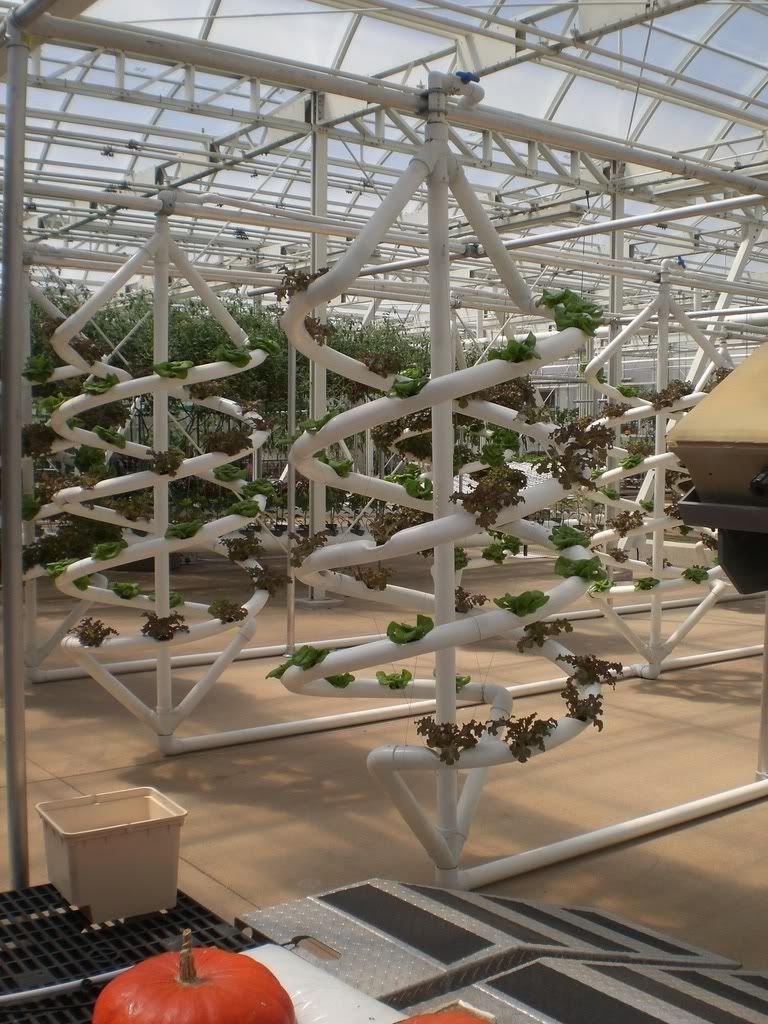
Hydroponic agriculture at the "The Land" pavilion at EPCOT. One of the few (only?) places that's actually doing any research at EPCOT, which was the original dream Walt had for the park. Hydroponic agriculture has undergo a remarkable transformation to increase crop yield in developed nations and has gain interest in many countries. Through Hydroponic method, higher crop yield can be achieved at a relatively faster growth rate as to compare to the traditional soil based farming. As the global demand for food is increasing in an extremely faster pace, the modern techniques of farming is the only solution and Hydroponic is one of the brilliant choice.
________________________________________________________________
Foto-foto ini menunjukkan model tanaman Hidroponik termoden yang terdapat  di EPCOT, USA, satu-satunya yang terdapat di dunia. Di taman ini (yang dibina di dalam gedung Greenhouse yang sangat besar mengandungi model-model tanaman Hidroponik, Fertigasi dan Aeroponik yang dimajukan dari R&D. Di sini, kita tumpukan pada tanaman Hidroponik yang telah melalui transformasi yang ketara pada pertunjukan model tanaman ini di situ. Melalui kaedah Hidroponik yang tercanggih, hasil yang lebih tinggi dengan kadar pertumbuhan yang tinggi dapat dicapai berbanding dengan tanaman secara tradisi di atas tanah. Memandangkan permintaan
 dunia yang kian meningkat terhadap makanan dan hasil pertanian manakala jumlah tanah yang berkurangan akibat dari pembanggunan dan industri serta kualiti tanah yang semakin tercemar, maka kaedah moden adalah satu-satunya penyelesaian yang ada dan Hidroponik adalah salah satu dari pilihan yang paling bijak
Hidroponik DFT yang dimajukan
Technorati:
Hidroponik/Hydroponic
Tuesday, April 22, 2008
Transformation of Hydroponic Farming / Transformasi Penanaman Hidroponik
n lebih lazat, rangup dan tekstur yang lebih baik. Para pengkaji telah menemui cara-cara untuk mengurangkan ruang penanaman dan meningkatkan hasil. Pengagihan nutrien dilakukan dengan menggunakan sistem irigasi berkomputer yang tercanggih. Malah mereka menggunakan sistem getaran atau vibrasi untuk proses pendebungaan tanpa perlu menggunakan ejen serangga atau angin yang tidak konsisten. Inilah yang dikatakan pertanian masa depan
Technorati:
Hidroponik/Hydroponic


